Earth, Bread and Grave
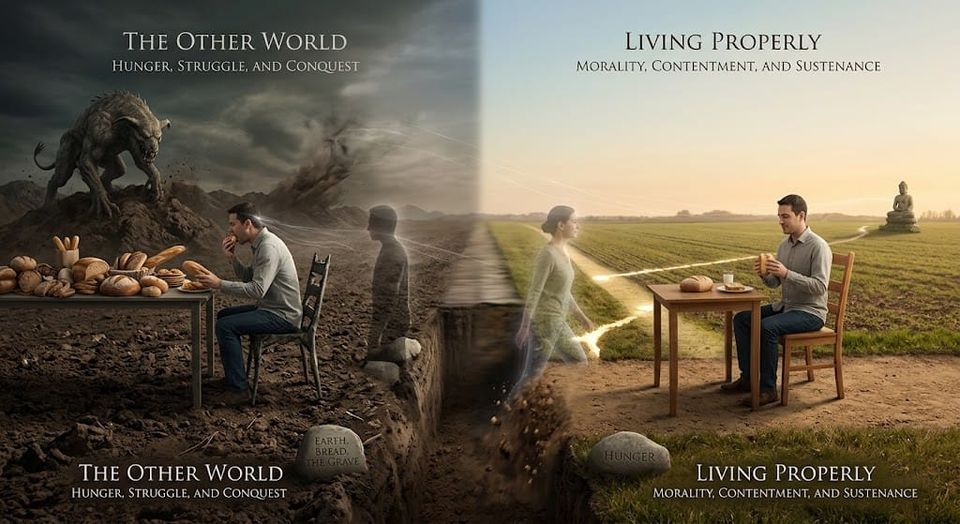
Earth, Bread, and the Grave
Hunger
There are more worlds within this world than most are aware of. This is a lesson unto that other world, the one that finds itself in contest with this one, asking: Which world is real? To her, to him, and to me.
To say that the other world is beyond the grave, that it is simply the land of the dead, does not settle the matter. There is still movement from here to there, from what came before to what happens next. So let us not concern ourselves too heavily with destinations. Let us discover where we are right now, what stands between us, and where our boundary actually is.
As I have said, there is here, there, then, and before. These are movements. And I think you can agree that there is movement. And because there is movement, there is us. There is you, and there is I.
“Beyond the grave” becomes a way of saying: that is where I will be, and where you were. But for me there is anxiety in that, and for you there is longing. This does not work for either of us. So we will discard the explanation, because it does not work. And unto you I say: look, you were not discarded with it. So you must work as well.
Let us simplify this. What is hunger? Is this not simple enough? We have lived with it. It surrounds us. Whether within myself or within another, there seems always to be hunger. I must live with it, apparently, and according to that discarded understanding of the grave, I must carry it with me beyond death as well. You see? It still does not settle.
Hunger is here, in my world, as an urge to overcome. I am hungry, therefore there is something I must overcome to satisfy that hunger. But let us be clear about what I am calling hunger in this lesson. The body needs nourishment. It needs bread. I am speaking of the urge that continues even when there is enough, the hunger that finds another thing to conquer as soon as the first has been overcome.
I must overcome the beast. I must overcome the plant. I must overcome the world. I must push my body to its limit so that I may overcome the limit itself. This, too, I call hunger. As long as I believe there must be something to overcome, there will be something upon which this hunger can feed.
Yes, seemingly, you can use hunger. But how do you overcome hunger itself? Can you? Or have you only given it another thing to overcome?
Let us examine this beside fear, because I believe fear and hunger have a relationship. Hunger can even seem to overcome fear. A person may move toward what frightens him because he wants something beyond it. But notice that the hunger has not ended. It has simply become stronger than the fear.
I sit upon a chair. The chair is a fact. No matter what I say to it, it remains a chair. Outwardly I am sitting upon it, and inwardly I am comfortable. You see, there is something within and something without. Forgive this silly use of “without.” I am saying that the chair is there, outwardly, while my experience of sitting upon it is here, inwardly. These are related, but they are not the same thing.
Still, the chair remains. My mind, noticing that no amount of argument changes this, must eventually settle the matter. Perhaps the argument becomes: am I comfortable enough? Would I rather have another chair? But notice what happened. The chair did not become an argument. I brought an argument to the chair.
Now fear. I sit upon it, or perhaps within it, also. A monster may appear before me and frighten me, but when I examine what I am experiencing, there is the image of the monster, and there is my fear. It is difficult to separate them. The image seems to explain everything. Yet if I set the image aside for a moment and attend to fear itself, what am I looking at? I can feel it. I can notice what it does within me. But I cannot point to it as I point to the chair.
Arguing with the image may leave the fear exactly where it was. So I ask whether I can depart from my occupation of it, much as I would rise from the chair. I do not mean that every danger disappears when I stand. I mean that sitting within fear and seeing what frightens me are not necessarily the same thing.
And now hunger. I sit in hunger. You see the difficulty. If I sit in it as I sit upon the chair, if I attend to it as I have attended to fear, what is there that still must be overcome? Here I am, sitting within the very thing that tells me I must be somewhere else, possess something else, become something else. I have, in a sense, fed myself to it. Yet it continues asking for more.
Explore this. It is quite fun, and I do not want to steal this hunger from you. It is quite the lesson. But notice: when I sit with the urge, I do not necessarily have to obey it. It may insist that something is missing. Its insistence does not tell me what is missing, or whether taking something will settle it.
What an illusion this hunger can be. There is a sleight of hand here, something unseen between the feeling and the command. I feel a need, and suddenly the world owes me an answer. I feel an absence, and suddenly something must be taken, defeated, or made mine. But how did we arrive at that? How did the feeling become an instruction?
I would call this hunger a need that has lost its sense. Notice that word: sense. For I am already here. I have not vanished because I have not obeyed. The chair remains beneath me. The world has not become an enemy merely because I have felt an urge to overcome it.
So let us speak of the proper way. If I live properly, I may live without making everything a contest. I may eat and be nourished. I may rest and be rested. There need not be another conquest hidden within every ordinary act. But when I fall out of accord with this, something appears that I believe I must overcome. Hunger returns with its familiar command: I must overcome the world I live in.
Longing brings this hunger. Anxiety brings it as well. Now I must overcome the longing. I must overcome the anxiety. I must overcome the world I have decided is responsible for them. Hunger believes it can overcome anything. Look deeply into that. Even the wish to be free of hunger can become another of its demands.
But consider living properly. This is what I am drawing from the Buddha’s Eightfold Path: a way of living in which craving need not command every step. Morality belongs to this as well. I can ask what is right before asking what I can possess. I can attend to what sustains life before deciding what must be conquered.
I live in morality. I practice the path. And the mind and body may come together without that endless command to overcome. The body is cared for. There is bread upon the table. There need not also be a beast to conquer, a world to defeat, a boundary to break merely to prove that I am here.
Now it is simply living. And perhaps this is one of the clearest ways this hunger reveals itself: when needs multiply without end, ask what fear is multiplying with them.




Member discussion