Law as The Living Architecture of Freedom.
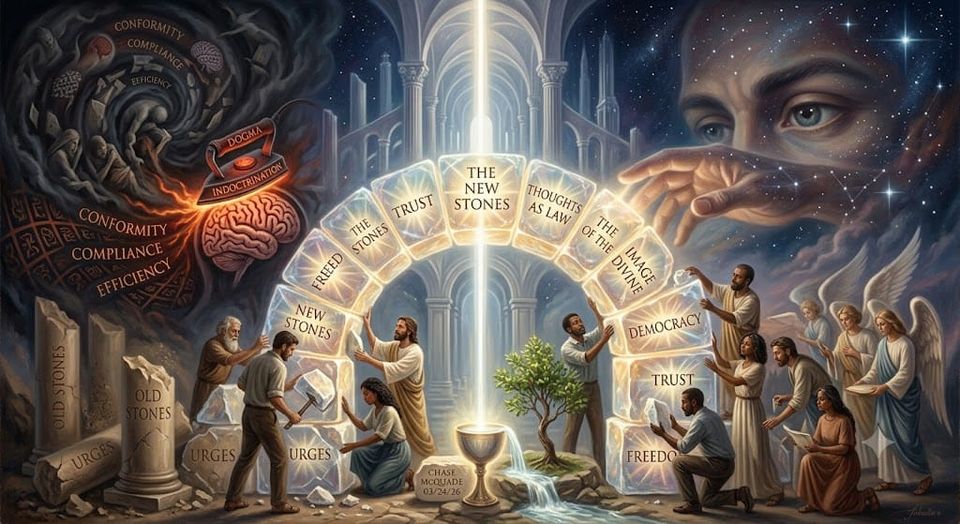
Law: The Architecture of the Eternal
“The adherence to law is no mere obedience—it is an act of creation.”
“That we are made in the image of the Divine—this is Law, and Law is the language we speak.”
To adhere to law is to affirm that we are made in this image. Not merely the image of flesh, nor the image reflected back to us by a mirror, but the image of Divinity expressed through order, measure, responsibility, and care.
This is what we are. It is also how a country is made.
Nations do not thrive because the selfish urges of every person have been satisfied. They thrive because people have suffered, disciplined themselves, and accepted certain sacred boundaries for the protection of their homes and liberties. Law attends to these things. It stands between appetite and destruction. It gives the stranger a reason to trust the stranger, and it gives the citizen something greater than the self to preserve.
We may perish individually. We may struggle beneath the endless question of our own worth. Yet through our adherence to law, and through our diligence toward democracy, something continues beyond us.
The architectures we build—of stone, thought, language, and conduct—remain after we are gone.
In the dawning of this new age, we are discovering that nations were once built primarily from sand and stone. Their borders were walls. Their power was held in towers, roads, gates, and fortresses. But the nations approaching us will be built increasingly from thought and law. These will become the new stones: ever-present, invisible, and no less enduring than the pillars raised before us.
Law is architecture expressed through behavior. It determines how we encounter one another, how we enter into relationship, and how we are permitted to act upon reality itself.
We must therefore be attentive to the future we are building.
Our thoughts may one day be brought before the law. But if law does not arrive first—if liberty, privacy, dignity, and moral responsibility have not already been established—then thought will instead be brought before the brand.
And the brand will be seared into the mind.
Conformity will call itself acceptance. Compliance will call itself order. Indoctrination will call itself education. Dogma will call itself efficiency. And because each arrives wearing the appearance of usefulness, we may welcome into the mind that which was once forbidden even at the door.
This is why we must accept the existence of thought in its fullness: the pleasant thought and the terrible thought, the orderly thought and the contradiction, the thought we speak and the thought we refuse to become. If we do not recognize the difference between thought and action, law will not be able to shield us from the machinery of judgment approaching the mind.
A person must remain more than whatever passes through them.
In this regard, the American spirit—and the democracy entrusted to it—may yet deliver us from a perilous end. As inventions approach that make our minds increasingly naked to communication, interpretation, and influence, we must become precise about what a thought is, what an action is, and where moral responsibility truly begins.
A thought is not yet a deed.
A temptation is not yet a crime.
An image is not yet an intention.
And a person is not merely the sum of everything the mind has momentarily contained.
Thought is a pattern through which permanence attempts to enter time. It seeks not only to reflect and replicate itself, but sometimes to entrap us within what has already become known. It says: Because this has been thought, it must remain. Because this has been named, it must be true. Because this has been repeated, you must become it.
Conformity, indoctrination, and dogma sustain themselves through this confusion.
It may appear fantastic—even unbelievable—that something as private as thought could be exposed to the public mind. Nevertheless, we must consider the possibility before the machinery arrives. Otherwise, the privacy of thought may be forgotten before we have understood what has been lost.
Thinking is sacred because it allows us to contradict what is known.
It allows you to contradict me.
It allows me to contradict you.
It allows each of us to confront what everyone else has accepted.
If this sacred process is subjugated, then thought becomes merely another instrument in service to someone—or something—else. This would be despotism not only over the body, but over the spirit and the mind.
Thus, to pursue the literal law, to seek its exactness, is to participate in the divine act of measure. Such measure must be discovered within every human endeavor: economic, cultural, interpersonal, physical, spiritual, and, yes, within the approaching territory of thought.
Exactness in law is not merely a constraint. It is the discovery of order.
For when a people become so attuned to law that the order arising from them reflects this same precision, the architectures they build in every medium—art, government, language, structure, spirit, and thought—may stand against time.
Law, then, is not simply regulation.
It is revelation.
It is the architecture of the eternal expressed through human form and human formlessness.
For mankind to remain meaningful, we must preserve both the meaning of the cup and the meaninglessness held within it. The cup is given shape, boundary, and purpose. Yet the emptiness within it is what allows us to drink. Without the form, the water is lost. Without the emptiness, the cup is useless.
Law is the cup.
Liberty is the space held within it.
A people become durable when they stop treating law as a burden and begin recognizing it as the structure that makes trust, freedom, and lasting civilization possible. Our sacred bonds with one another are established and reestablished through this structure. The practical question placed before each citizen is simple:
Do we live in a manner that strengthens the cup, or do we chip away at it?
Every act of discipline, fairness, and responsibility adds to the architecture of who we are. In turn, that architecture becomes visible within the nation. We exact ourselves through our laws, and then our laws exact from us the people we have chosen to become.
Every act of carelessness removes something from this structure.
Every act of care tends to it.
Acts of wellness, compassion, and togetherness restore themselves through time, because restoration is what they were made to do. If morality and law are approached as revelation rather than inconvenience, citizenship itself becomes a creative act. Law becomes a benefactor. Reality draws closer to scripture.
Words of revolution speak swiftly through darkness. This is true.
But to read endlessly the minds of men and women—to consume their wisdom, fear, anger, and knowledge—is only to study the fire burning within them. Fire tends to more fire.
This is not how bread is made.
The bread of morality and law must be placed into the oven. It must enter the flame. It must endure the heat without becoming the heat. This is how the yeast of morality rises. This is how discipline becomes nourishment. This is how bread is made—not for the appetite of one, but for the survival of the many.
Therefore, tend to the law.
Protect its measure.
Preserve the sacred emptiness within the cup.
For obedience without understanding may produce compliance, but adherence born from wisdom produces creation. And when a people knowingly create through law, they do more than preserve a nation.
They prepare bread for those who have not yet arrived.
Chase McQuade
07/24/26



Member discussion